Modern rendition of the signs that marked all the ZCMI stores.
David M. Whitchurch
The cast iron façade was eventually incorporated into the modern downtown mall located where ZCMI once stood.
Kathie and W. Jeffrey Marsh
Preserved on main street is the original cast-iron façade of Zion’s Cooperative Mercantile Institution, sometimes claimed to be the first department store in America (organized in March 1868). The store began as a response to price gouging in Salt Lake City. During the early pioneer days, basic commodities from the eastern United States were scarce and expensive because they had to be hauled by ox team from Missouri. Aware of this predicament, various Salt Lake merchants took advantage of the situation and asked exorbitant prices for their goods. At one time the price for a sack of sugar rose to one hundred dollars, and something had to be done about it.
President Brigham Young’s answer was to encourage the Saints to organize cooperatives. Some private store owners joined the cooperative movement, and some communities organized their cooperatives from scratch. Soon there were 146 Church sponsored branches of ZCMI throughout the territory, all offering the same merchandise for the same prices. Each ZCMI establishment had the standard “Holiness to the Lord” sign over the front door. The Saints benefited by lowering costs and having a trustworthy outlet to sell their goods.
For a time, most businesses owned by Church members became part of the ZCMI businesses, numerous private store owners also joined Zion’s Cooperative Mercantile Institution. Note the small ZCMI signs on each store.
Daughters of Utah Pioneers
The large department-store ZCMI building on Main Street, located behind the façade, was constructed in three sections between 1876 and 1901. During the more than one hundred years following its institution,various wings were added as the cooperative expanded and modernized (modernizations included electricity, cash registers, and elevators).
Previously, coal oil lamps lit the building and money was dropped into black kettles, which were periodically gathered by clerks and taken into offi ces, where the money was counted and recorded. The old façade has been preserved and will be part of the rising City Creek Center. It is a beautiful historic landmark and reminder of the ingenuity and industry of the early Utah settlers.
A re-creation of the old ZCMI interior found in the Pioneer Memorial Museum, Daughters of Utah Pioneers.
David M. Whitchurch
In 2000 the Church sold all its ZCMI holdings to Meier and Frank, bringing an end to Church involvement in competitive retail trade.
Delivery wagons line up on Main Street in front of ZCMI.
C. R. Savage courtesy of Richard K. Winters
Homesite of Jedediah M. Grant
The lot where the south end of the ZCMI façade now stands was the homestead of Jedediah and Rachel Grant. Jedediah M. Grant was the first mayor of Salt Lake City and served in the First Presidency as Second Counselor to President Brigham Young from 1854 to 1856. When Jedediah
died in 1856 at the age of forty, Rachel was left to raise their son, Heber, who was only ten days old. Rachel never remarried, and President Young took a special interest in the young, fatherless
son of his counselor and friend.
Heber was a frequent guest at the Lion House, just a halfblock northeast of the Grant homestead at the intersection of Main Street and South Temple. “I was almost as familiar in the homes of Brigham Young as I was in the home of my mother,” Heber explained. “I knelt down time and time again in his home in the Lion House at family prayers, as a child and as a young man.
I bear witness that as a little child, upon more than one occasion, because of the inspiration of the Lord to Brigham Young while he was supplicating God for guidance, I have lifted my head, turned and looked at the place where Brigham Young was praying, to see if the Lord was not there."
Home where President Heber J. Grant lived as a boy located near where the ZCMI façade now stands.
L. Tom Perry Special Collections, Brigham Young University
Heber J. Grant was the first President of the Church born in Utah. He liked to share stories from his youth about things that occurred on or near this lot. He presided over the Church from 1918 to 1945, which included the years of the Great Depression and World War II. He used examples from his life about overcoming poverty to inspire the Saints to climb out of despair and the difficult conditions that surrounded them.
“My mother was keeping boarders at the time for a living,” he explained to the Saints, in reference to his youth, “and I shined their boots until I saved a dollar, which I invested in a base ball. I spent hours and hours throwing the ball at a neighbor’s barn (Edwin D. Woolley’s,) which caused him to refer to me as the laziest boy in the Thirteenth Ward. Often my arm would ache so that I could scarcely go to sleep at night. But I kept on practicing, and finally succeeded in getting into the second nine of our club. Subsequently I joined a better club, and eventually played in the nine that won the championship of the Territory. Having thus made good my promise to myself, I retired from the base ball arena.”
Heber J. Grant (center) with his Red Stocking Baseball teammates, who were Utah Territorial Champions in August 1877.
L. Tom Perry Special Collections, Brigham Young University
As illustrated in President Grant’s story, he adopted a slogan in his life: “That which we persist in doing becomes easier for us to do; not that the nature of the thing itself is changed, but that our power to do is increased."
A counselor in the First Presidency and the first mayor of Salt Lake City before his untimely death in 1856. His property was located on the block of the ZCMI building immediately south of South Temple Street.
Daughters of Utah Pioneers
Horses and carriages in front of ZCMI.
Daughters of Utah Pioneers
Ute Indians in front of the ZCMI at the Eagle Emporium building on Main Street in Salt Lake City. C. R. Savage courtesy of Richard K. Winters
Example of first telegraph equipment used.
Daughters of Utah Pioneers
The telegraph office was located on the east side of Main Street, south of Temple Square. Daughters of Utah Pioneers
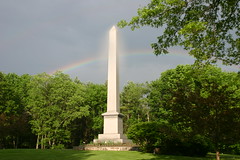
The overland telegraph monument marks the site where the transcontinental telegraph lines met, stretching from the Pacific to the Atlantic oceans. The telegraph connection to Salt Lake City was completed on October 18, 1861, and provided the Saints with the ability to maintain contact with the outside world. It also provided much needed employment to the Latter-day Saints who supplied poles, subsistence, and transportation while constructing approximately five hundred miles of line. During the Civil War, two units of the Nauvoo Legion protected Overland Telegraph lines. This great innovation also allowed Mormon wagon trains to communicate their progress and, when necessary, to request the help of relief parties. Completion of the telegraph led to the demise of the Pony Express.
Marker on Main Street showing location of original telegraph office.
Kathie and W. Jeffrey Marsh
The First Telegram
Recognizing the impact of the transcontinental telegraph line, the Sons of Utah Pioneers erected this marker in its honor on October 18, 1955. The marker contains the first messages sent and the following inscription:
At this location on October 18, 1861, stood the telegraph pole, shown on above plaque on which telegraph wires were joined which spanned a continent and united two oceans.
On that date the first two telegrams transmitted were as follows.
“Hon J. H. Wade. Great Salt Lake City, U.T.
President of the Pacific Telegraph Company
Oct. 18, 1861—Cleveland, Ohio
Sir permit me to congratulate you upon the completion of the overland telegraph line west to this city to commend the energy displayed by yourself and associates in the rapid and successful prosecution of a work so beneficial, and to express the wish that its use may ever tend to promote the true interests of the dwellers upon both the Atlantic and Pacific slopes of our continent. Utah has not seceded but is firm for the constitution and laws of our once happy country, and is warmly interested in such useful enterprises as the one so far completed.
Brigham Young.”
The reply was as follows:
“Hon Brigham Young President
Cleveland Oct 19, 1861—Great Salt Lake City:
Sir, I have the honor to acknowledge the receipt of your message of last evening which was every way gratifying, not only in the announcement of the completion of the Pacific telegraph to your enterprising and prosperous city, but that your, the first message to pass over the line should express so unmistakably the patriotism and union-loving sentiments of yourself and people.
With just consideration for your high position and due respect for you personally. I am your obedient servant, J. H. Wade, Pres. Pacific Telegraph Company
G. S. L. City, Oct 18. 1861"
"I have been sharing this information with friends around the world and the response is outstanding. These tours contain information that we could never access on our own and can be shared and treasured forever."
Frank M. McCord
National Chair
BYU Friends of Religious Ed.
Everett, Washington
Brigham Young University Religious Education presents
Hallowed Ground
Sacred Journeys
featuring BYU Religious Educators teaching about sites significant to
The Church of Jesus Christ
of Latter-day Saints.
"A great source for weekly Mormon Church History Videos"
"One of the finest projects ever to come out of Religious Education at Brigham Young University."
- Arnold K. Garr, BYU Church History and Doctrine
"This is really cool. Thanks. I just hope I don't spend every day on virtual vacation." -Steve
"These documentaries bring these church history sites to you. I have enjoyed viewing them. They are very well done." - Wayne
"It was very spiritually and historically based. I enjoyed reading/hearing about the past and being able to see the differences and the inspiration the prophets had for the future." -BYU Student
"Wow, what a great program! My kids loved it. Each piece was packed with information and it kept their attention." -Debbie
"This is a GREAT idea. Thanks..." -Leila
"I loved the incredible knowledge the tour guides had as well as the music set to each historical site." -BYU Student
"Absolutely fabulous! The historical background information about each place really made it come alive. -Anderson Family
"The Virtual Tours program re-states, for all to hear, the testimony of Jesus Christ that the early pioneers had and what they went through to bring the revelations of scriptures to light." -BYU Student